Why Play is Serious Business: The Role of Creativity in Human Flourishing
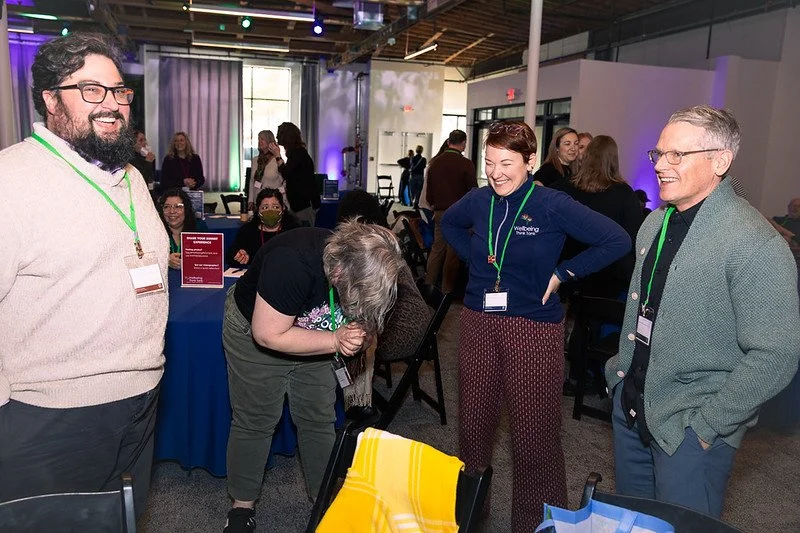
Play is often treated as something separate from serious work, but research suggests it may be one of the conditions that helps people think, connect, and adapt.
In this guest reflection, we explore how creativity and play can support human flourishing, workplace wellbeing, and the kind of flexible thinking organizations need for the future.
In a high-stakes work environment, many organizations have been conditioned to believe that labor requires a somber atmosphere and that levity is a luxury reserved for after hours.
But as we explore the Art and Play for Human Flourishing this quarter, the evidence points in a different direction. Play is not a diversion from serious work; it’s one of the conditions that can help make high performance more sustainable over time.
The High Cost of the Seriousness Trap
Many organizations operate under a grind culture that treats play as a distraction. Paradoxically, this rigid focus on seriousness can produce the very outcomes leaders fear most: narrow thinking, low innovation, and burnout.
Play is broadly understood as activity that is enjoyable, freely chosen, absorbing, and centered on the process. In the workplace, researchers have also described play as the ability to bring lightheartedness into work. When organizations strip play from the workplace, they may also remove some of the conditions that help people navigate ambiguity, connect with others, and stay open to new ideas (Fletcher & Thornton, 2025).
The result is a workplace where people may be present, but not fully engaged.
The Biological Reality: Why We Need Play to Grow
From a neuroscience perspective, play is connected to brain systems involved in learning, social functioning, emotional regulation, and cognitive flexibility (Canepa & Ramenghi, 2026). This matters because sustained stress can narrow the brain’s cognitive range. Under chronic pressure, the prefrontal cortex, which supports planning, reasoning, regulation, and complex decisions, becomes more vulnerable to disruption (Arnsten, 2009).
Play and creative engagement can help shift people out of a state of threat response and into a more open, exploratory state. This doesn’t mean that simple play eliminates stress or solves systemic workplace problems., but rather it means play can create moments where the brain has more room to think, connect, and adapt.
Psychologist Barbara Fredrickson’s broaden and build theory offers another useful lens. Positive emotions, including joy, curiosity, and interest, can expand the range of thoughts and actions available to a person in the moment. Over time, those experiences can help build social, intellectual, and psychological resources (Fredrickson, 2001).
Cognitive Flexibility and the ROI of Play
For HR leaders and workplace wellbeing practitioners, play can be a strategic asset. It supports cognitive flexibility, which is the capacity to hold multiple ideas at once, shift between perspectives, and respond adaptively to change.
Research by Peral and Weitz found that empowering leadership can support playful work design, which is associated with higher work engagement. When leaders give employees more autonomy and authority to make decisions, employees are more likely to incorporate elements of fun, creativity, and challenge into their work in ways that support engagement (Peral & Weitz, 2025).
Teams that are safe enough to play also get more practice with experimentation in low pressure settings. They learn how to try, adjust, laugh, recover, and keep moving. These are the skills people need when the answer is not obvious and the environment keeps changing.
Actionable Insights for Leaders
Integrating play into workplace culture requires intention more than a budgetary investment. Here are a few ideas that individuals and organizations can put into action:
Reframe failure as experimentation. During team meetings, replace “Why did this fail?” with “What did this experiment teach us?” This simple shift can reduce defensiveness and keep people in a state of learning.
Create space for unstructured thinking. Not every meeting needs a fixed outcome. Allowing teams time to explore ideas without the pressure of an immediate deliverable can help keep minds sharp and ready for future problem solving.
Model playful leadership. When leaders use appropriate humor, admit mistakes with curiosity, or engage openly in creative activities, they signal that it is safe to move out of performance mode and into genuine learning.
Build play into team rhythms. Brief creative warmups, collaborative challenges, or design activities in low pressure settings can normalize the kind of openness that sustained performance requires.
The Pathway Forward
Play is part of how human beings learn, connect, and adapt. By taking play seriously, organizations do more than support wellbeing. They create conditions for creativity, connection, and cognitive flexibility. It’s worth examining your team’s daily environment honestly. Are you creating conditions for survival, or are you building the conditions for human flourishing?
Wellbeing Think Tank brings together people who care deeply about creating healthier, more human workplaces. Learn how to join our community and stay connected to evidence-based learning and events throughout the year.
If you believe accessible, trusted resources should continue to be available to all, consider making a tax-deductible donation. Your support helps us continue to offer education you can trust, inspiration that you need, and resources so you can take action for wellbeing.