Building a Culture of Wellbeing Through Collaboration, Data, and Creativity
What does it take to build a culture of wellbeing that people actually experience in their day-to-day work?
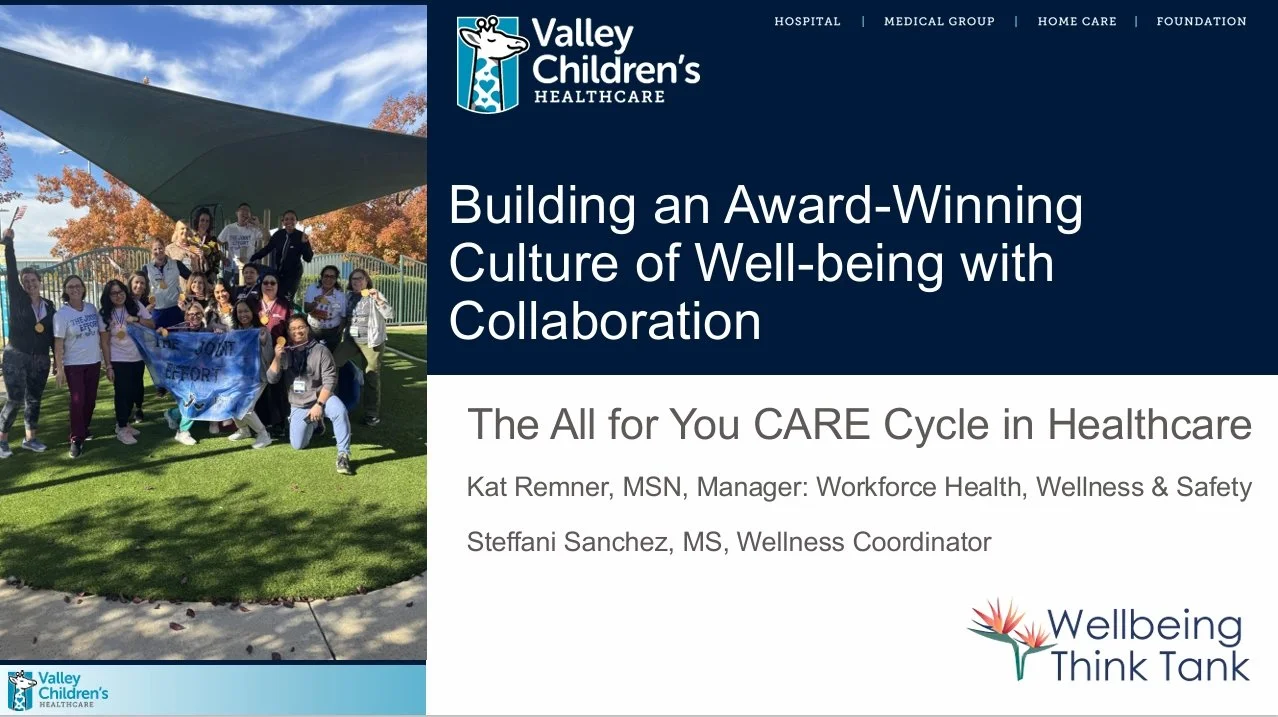
At a recent Wellbeing Think Tank event Kat Remner and Steffani Sanchez shared how Valley Children’s Healthcare has approached that question through collaboration, employee listening, and a willingness to keep adapting.
Culture Is Bigger Than Programming
One of the clearest themes from the session was that workplace wellbeing cannot be reduced to a calendar of activities.
Kat and Steffani described how their approach evolved as they began looking beyond the boundaries of a traditional wellness program. Rather than assuming their team needed to create everything themselves, they looked across the organization for people, departments, and resources that were already contributing to employee wellbeing in different ways.
That shift reframed their work, and the question became less about, “What should wellness do?” and more about, “What are we trying to accomplish, and who can help us do it?”
For workplace wellbeing leaders, it is important to take a step back and remember that stronger strategies don’t necessarily require more programs, sometimes they just need stronger connections.
Listening Has to Be Ongoing
The session also reinforced that employee listening is not a one-time activity.
Formal surveys and participation data matter, but Kat and Steffani also emphasized the value of everyday signals: what employees are saying, what managers are noticing, where requests are increasing, and where engagement may be lower than expected.
If something isn’t working as expected, the answer may not be to push harder, instead ask what the response is telling you.
During the live session, participants reflected on some of the barriers they face in bringing wellbeing into the workplace. Time quickly emerged as a major theme, along with capacity, competing priorities, leadership participation, and engagement.
Those responses reinforced an important question: are we designing wellbeing around what employees actually have the capacity to engage with?
Meet People Where They Are
For Kat and Steffani, accessibility became a central part of how they approached that challenge.
Their experience highlighted the importance of bringing wellbeing closer to where work is actually happening, particularly in an environment where employees may not always be able to step away.
The session included several creative examples of how their team has made wellbeing more visible and approachable without expecting employees to leave the realities of their work behind. Those examples also demonstrated how small interactions can create opportunities for connection, trust, and better understanding of employee needs.
The larger lesson wasn’t about replicating a particular activity, but about designing strategies with your workforce instead of simply for them.
Community Reflections
The live conversation made it clear that many wellbeing professionals are navigating similar challenges in executing strategies that shift the culture at their organization.
They also identified potential wellbeing partners that are sometimes overlooked, including facilities, safety, IT, unions, and other teams outside the traditional wellness function.
That discussion reinforced that the people who can help strengthen workplace wellbeing may already be inside your organization.
Taking Action
This week, choose one wellbeing challenge in your organization and ask: Who else should be part of this conversation?
Instead of beginning with a solution, look across your organization for people with relevant expertise, relationships, influence, or insight and ask more questions.
This can reveal opportunities that would be easy to miss when wellbeing work stays within a single department.
Continuing the Conversation
Kat and Steffani also introduced the All for You CARE Cycle, a practical framework their team uses to guide how they collaborate, assess, respond, and evaluate to turn insights into responsive and measurable wellbeing actions.
Members with Professional and Practitioner access can watch the full session on demand through the Wellbeing Think Tank portal, including the full framework, applied examples, interactive discussion, and Q&A.
Wellbeing Think Tank brings together people who care deeply about creating healthier, more human workplaces. Learn how to join our community and stay connected to evidence-based learning and events throughout the year.
If you believe accessible, trusted resources should continue to be available to all, consider making a tax-deductible donation. Your support helps us continue to offer education you can trust, inspiration that you need, and resources so you can take action for wellbeing.
